Arna Wendell Bontemps
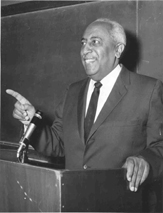
- The Man and His Works
- Arna Bontemps - a noted Black poet, author, anthologist, librarian - was born in Alexandria, Louisiana on October 12, 1902. He was baptized at St. Francis Xavier Cathedral. Arna, son of Paul Bismark and Marie Pembrooke Bontemps, lived in a typical turn-of-the-century, middle class wood-frame house at the corner of Ninth and Winn Streets. As a youth he moved with his family to California as a part of the great migration of that period.
- Arna attended public schools and graduated at age 17 from Pacific Union College (UCLA). He completed his degree in three years. While in college, Bontemps became interested in writing. He wrote poetry, essays, short stories, fiction, non-fiction, and children’s books.
- Arna Bontemps was also a teacher in a private academy in New York City. He received professional training in librarianship at the Graduate School at the University of Chicago and served as the librarian at Fisk University in Nashville, Tennessee. He and his wife had six children.
Bontemps' writings were greatly influenced by his memories of Alexandria, his cultural and social roots. As an adult, he returned to the South because of certain changes he observed as "Jim Crow" laws were being eradicated. Bontemps would later write in his novel, Black Thunder, "Time is not a river. Time is a pendulum...intricate patterns of recurrence in...experience and in...history."
Bontemps is credited with writing over 20 books, plays, and anthologies and considered the leading authority on the Harlem Renaissance. He was part of a core of young Black writers who led the "New Negro" movement. Bontemps wanted a front row seat to view and participate in the stirrings of jazz, theater and literature taking place in Harlem. His scholarly interest in fostering a new appraisal of his race and reevaluation of the Black man's place in American history is just a part of his legacy. His children's books are unique and his poetry and writings convey the rhythms and richness of the African American culture which was to influence a number of writers who followed him. (Edwin Blair. "Literary Habitats." Preservation in Print. September 1996.)
The recent resurgence of interest in Bontemps' unpublished children's stories by Oxford University Press speaks to his universal appeal. The 1996 Academy Award nominated short film, "A Tuesday Morning Ride," is an adaptation of Bontemps' 1933 short story, "A Summer Tragedy". The revival of his play, "St. Louis Woman," written with Countee Cullen and adapted from Bontemps' first novel God Sends Sunday, gives further credence to his literary genius.
When Arna Bontemps addressed the end of cultural colonialism, he wrote of the Harlem Renaissance writers and of their counterpart, the "lost generation": "Once they find a (united) voice, they will bring a fresh and fierce sense of reality to their vision of human life.... What American literature needs at this moment is color, music, gusto...." (Harlem Renaissance Remembered)
- His Awards
- Crisis (magazine) Poetry Prize, 1926; Alexander Pushkin Poetry Prize, 1926, 1927; Opportunity (journal) Short Story Prize, 1932; Julius Rosenwald Fellow, 1938-39, 1942-43; Guggenheim Fellowship for Creative Writing, 1949-50; Newbery Honor Book, 1949, and Jane Addams Children's Book Award, 1956, both for Story of the Negro; Dow Award, Society of Midland Authors, 1967, for Anyplace But Here; L.H.D., Morgan State College, 1969.